The Latency Ladder℠: A 30/60/90/6/12 Framework for Reading Discovery Signals
Clients and stakeholders always ask whether you are ranking yet, and whether AI is citing you. After nearly ten years of getting those questions, here is the framework I use to track, report, and prove the value of SEO and AI optimization — tested against my own Search Console data.

If you have ever done SEO work before, you know that clients, bosses, and stakeholders start asking questions like "are we ranking yet?" and "is AI citing us?"
I have run into these questions way too many times. In my nearly ten years of experience doing SEO, I have come up with a method for tracking, reporting, and proving the value of SEO and AI optimization in a way that most stakeholders can actually understand.
I call it the Latency Ladder℠, but more broadly it is a framework for understanding discovery marketing: SEO, AI optimization, and anything else where an index sits between you and your audience.
Here is what it looks like.
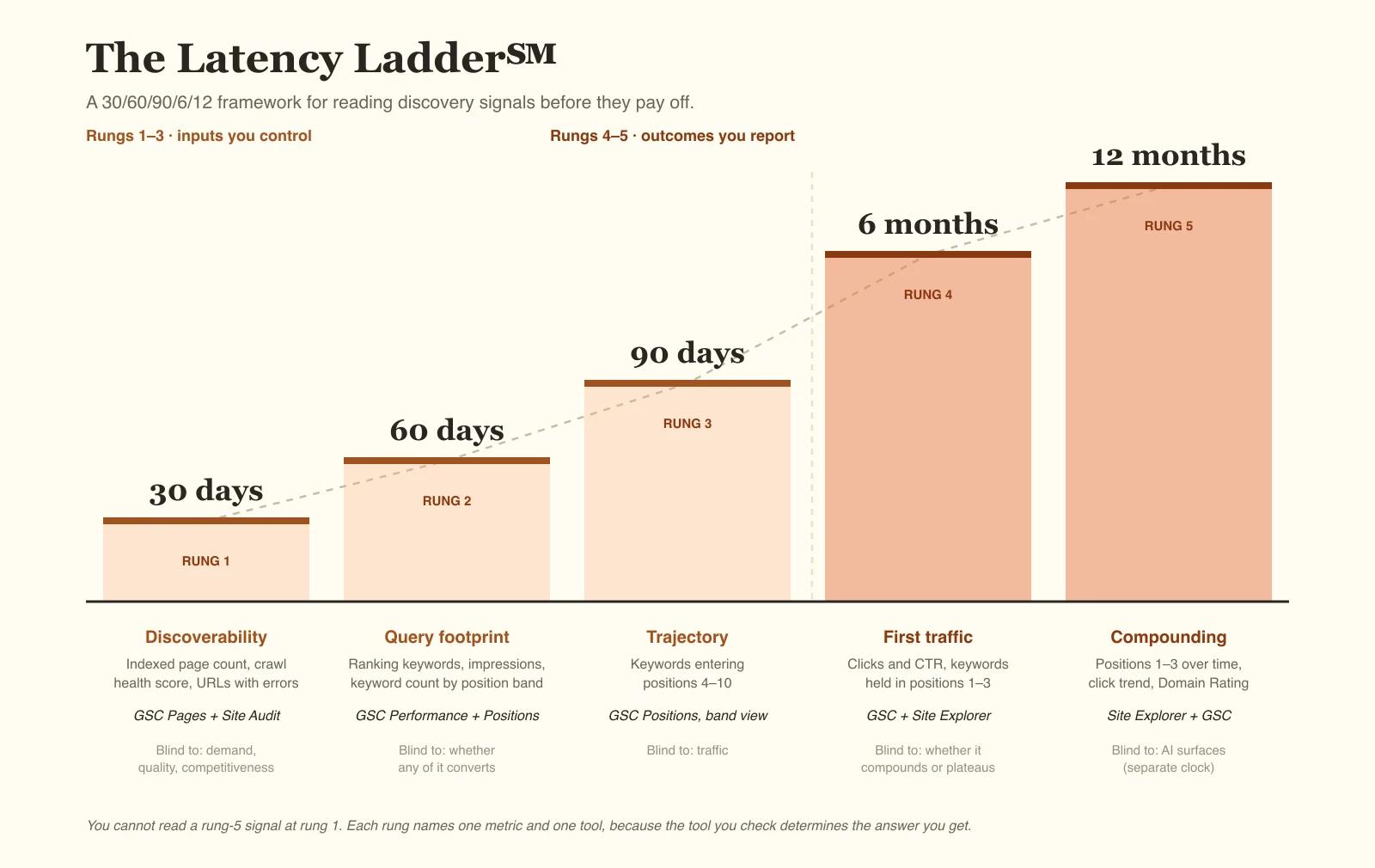
The Latency Ladder℠ — a 30/60/90/6/12 framework for reading discovery signals before they pay off.
Quick Links
- Why can't you tell if SEO is working in month one?
- Why do pages get impressions but no clicks?
- Is SEO latency a problem you can fix?
- How long does SEO actually take to show results?
- Which tool should you check at each stage?
- What do you measure at each rung?
- Does this work for AI search too?
- Where does the Latency Ladder break?
- How do you run it on your own site?
Everything below is measured against my own Ahrefs and Search Console data, pulled August 18, 2026. Where the data contradicts the framework, I have said so.
Why Can't You Tell If SEO Is Working in Month One?
Because discovery signals arrive in a fixed order, and the ones that answer "is this working" are last in line.
Each signal is a function of the one before it. Indexation has to happen before you get a keyword footprint, the footprint has to exist before impressions accumulate, and impressions have to accumulate before position means anything. Clicks come last.
Here is that sequence on my own site, week by week, from its first recorded search data.
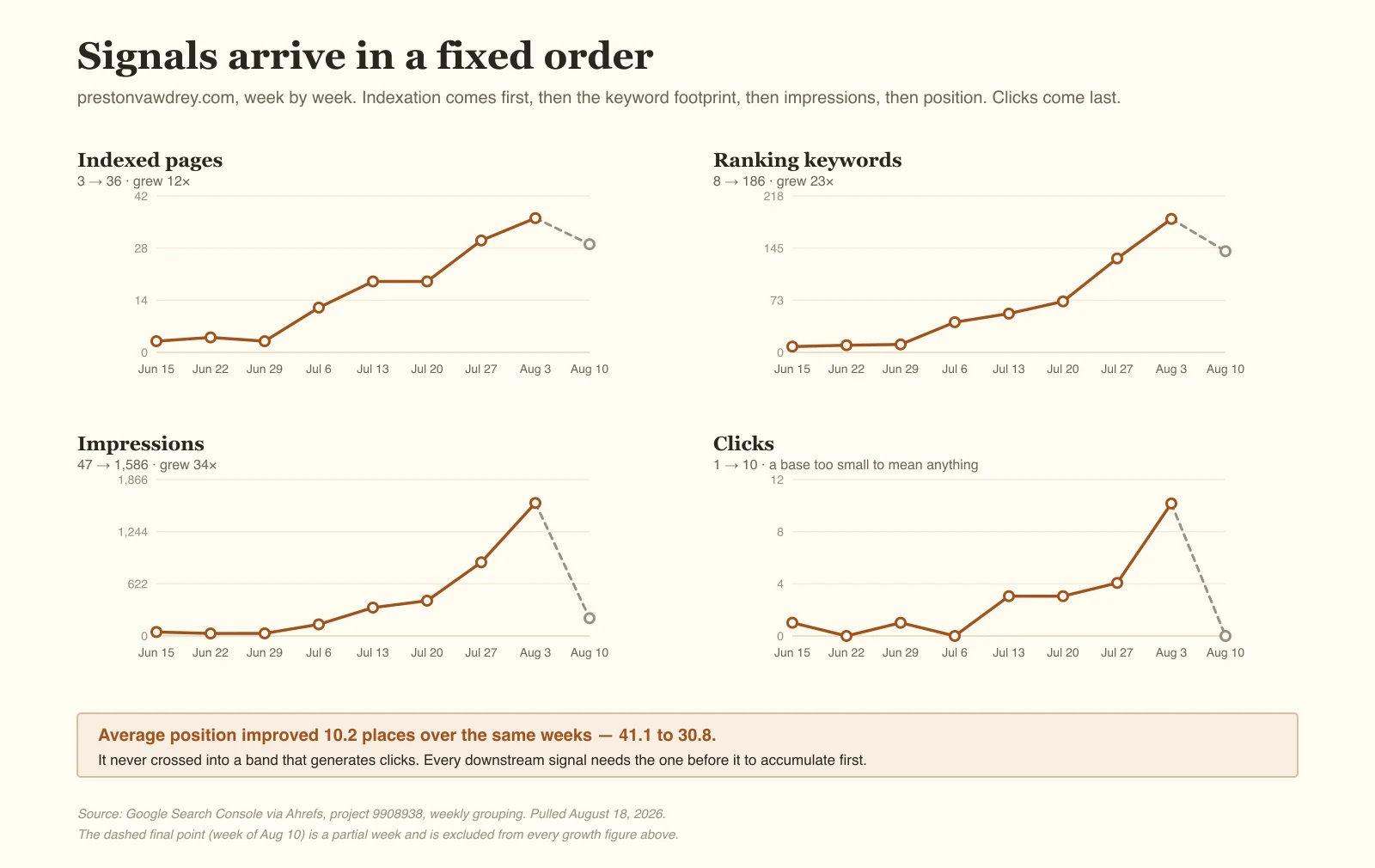
Over seven weeks, indexed pages grew 12 times over, ranking keywords 23 times, and impressions 34 times. Average position improved 10.2 places, from 41.1 to 30.8.
Clicks went from 1 to 10, off a base too small to mean anything.
So in month one there is a real, measurable answer available. It is just an answer about indexation and crawlability, not about traffic.
Why Do Pages Get Impressions but No Clicks?
Because impressions and clicks are different signals that become legible at different times, not the same signal at different volumes.
The clearest evidence I have is uncomfortable. All fifteen of the top fifteen pages on my site by impressions have zero clicks.
My SEO services page has 484 impressions and no clicks. A post ranking 55 keywords has 204 impressions and no clicks. My homepage sits at average position 9.7 and still has no clicks.
Meanwhile the only two pages producing clicks rank about twentieth by impressions, with 22 and 19 impressions each. The page converting reliably sits at position 5.1.
Page one was not the finish line
On this dataset, only the top five positions converted at all.
That is worth sitting with, because "we made page one" is one of the most common declarations of victory in SEO reporting. My homepage is on page one and generates nothing.
A page ranking 55 keywords with zero clicks is not a failing page. It has cleared rungs one and two and has not reached rung three.
Is SEO Latency a Problem You Can Fix?
No, and that is the point. Latency is not a flaw in the channel. It is a property you can schedule around.
Discovery signals mature on a delay, and different signals mature at different rates. Once you accept that, reporting stops being an argument about effort and becomes a sequencing problem.
Paid channels are the short-term position: you pay Google or Meta, traffic arrives today, and it stops the day the budget does. An SEO channel behaves like a 401k, compounding quietly and not evaporating when you stop paying.
I run SEO and paid ads together for the same reason a sane investor holds both a brokerage and a retirement account. It is a ladder because the rungs are sequential, and you cannot read a rung-five signal at rung one.
How Long Does SEO Actually Take to Show Results?
It depends entirely on which result you mean, and I have two datasets that put real numbers on it.
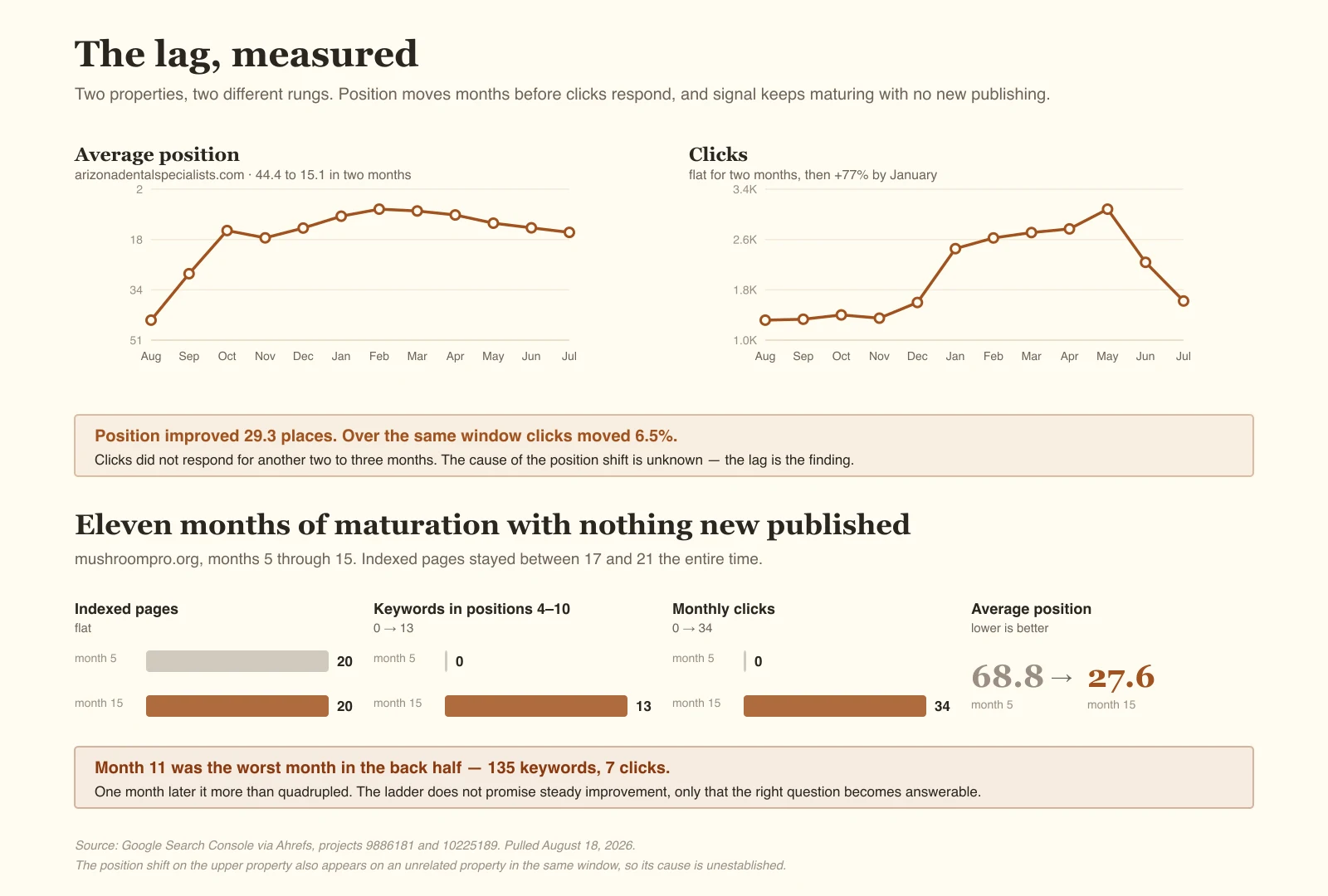
Position moved 29 places before clicks moved at all
On a client property, average position improved 29.3 places over two months. Clicks over that same window moved 6.5%, which is flat.
Clicks did not respond for another two to three months, then rose 77%.
A stakeholder auditing 30 days after that position shift would have concluded nothing happened. Something enormous had happened. It was not legible yet.
One honest caveat: the same position shift appears on a second, unrelated property in the same two months, which points at a reporting-methodology change rather than two independent wins. The lag is the finding. The cause is not established.
Eleven months of improvement with nothing new published
The second dataset is a 16-month-old site. From month five to month fifteen, indexed pages stayed between 17 and 21, so effectively no new publishing happened.
Over that flat window, keywords in positions 4 to 10 went from 0 to 13, average position went from 68.8 to 27.6, and monthly clicks went from 0 to 34. Nothing new shipped. The signal simply matured.
That site also recorded its first click in month six, after month five had already produced 204 ranking keywords and 910 impressions with zero clicks.
And month eleven was its worst month in the back half: 135 keywords, 7 clicks. One month later it more than quadrupled.
So the short answer is that trajectory is readable at 90 days, first traffic around month six, and compounding by month twelve. The ladder does not promise steady improvement, only that the right question becomes answerable at each rung.
Which Tool Should You Check at Each Stage?
First-party tools early, third-party tools later, because third-party indexes are still blind at 60 days.
This is the finding I did not expect, and it may be the most useful one here.
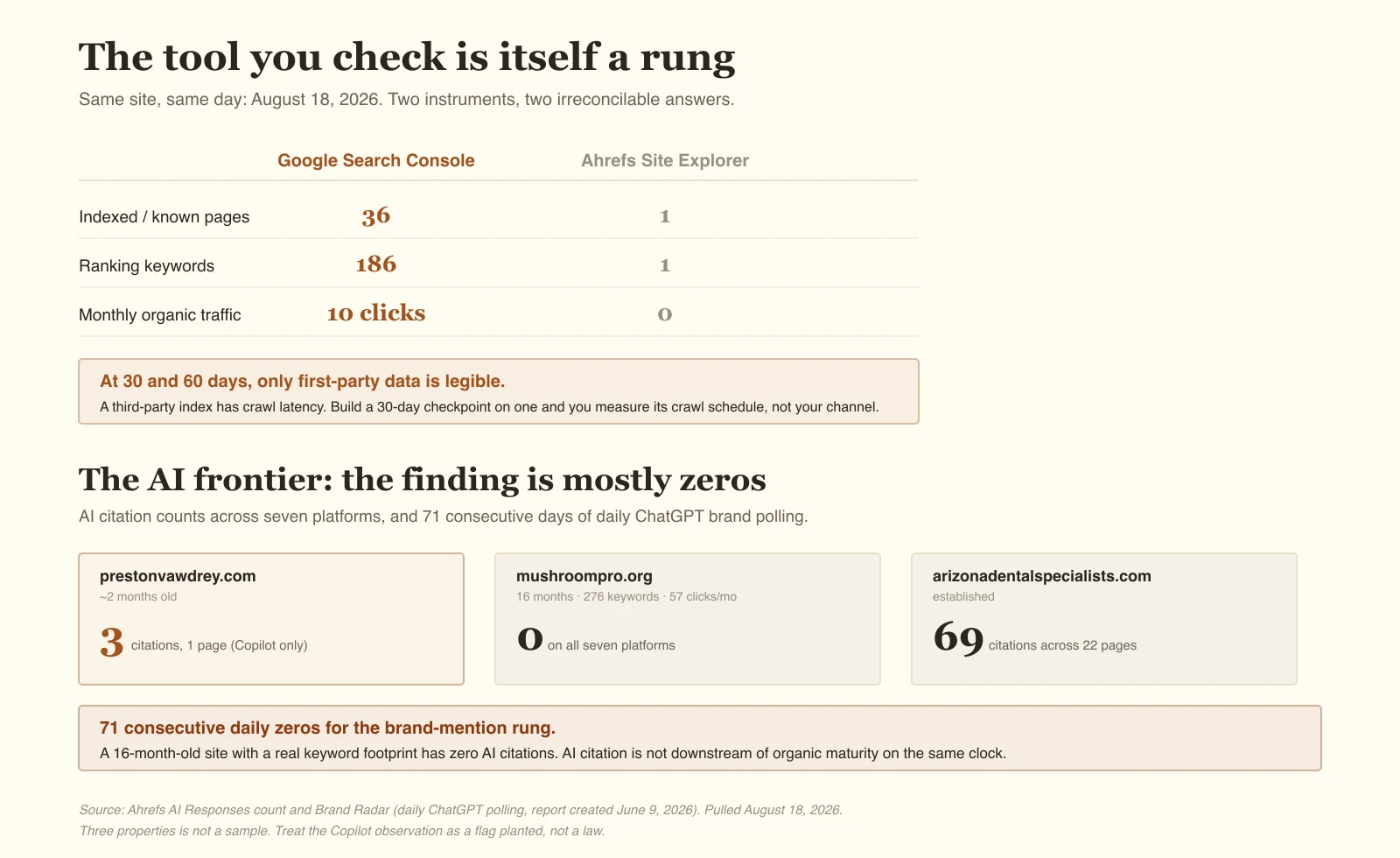
Same site, same day. Google Search Console reported 36 indexed pages, 186 ranking keywords, and 1,586 weekly impressions. Ahrefs Site Explorer reported one known page, one ranking keyword, and zero organic traffic.
That is not an Ahrefs failure. It is crawl latency, and every third-party index has it.
If your 30-day checkpoint runs on a third-party tool, you are measuring that tool's crawl schedule rather than your channel.
The tools can disagree on direction, not just size
On an established property, Ahrefs showed estimated traffic falling 10% over a window in which Search Console showed clicks rising 11%.
Neither is wrong; they measure different things. But "which tool" is not a footnote on a rung, it is part of the rung's definition.
The exception is technical health, which has almost no latency because a crawler reads your server rather than waiting on an index. That is exactly why it belongs at 30 days.
What Do You Measure at Each Rung?
One specific metric and one specific tool per rung. A rung that reads as abstract advice is not a rung.
Rung 1 — 30 days: is it discoverable?
Metric: indexed page count, crawl health score, URLs with errors. Tool: Search Console Pages report plus Ahrefs Site Audit.
It tells you whether you shipped something Google can read. It tells you nothing about demand, quality, or competitiveness.
Ten years in, I have never once opened an audit and found nothing to fix.
Rung 2 — 60 days: has Google given you a footprint?
Metric: total ranking keywords, impressions, keyword count by position band. Tool: Search Console Performance and Positions reports, first-party only.
It tells you whether Google has assigned your pages a query footprint, and how wide. It does not tell you whether any of it converts.
Rung 3 — 90 days: is the footprint moving the right way?
Metric: average position, and specifically the count of keywords entering positions 4 to 10. Tool: Search Console Positions report, position-band breakdown.
This is the first rung where trajectory becomes readable. It still does not tell you about traffic.
Rung 3 is also where authority work starts, and there is no clever version of it. Write genuinely good content, get it linked inside other people's content, and guest post where it makes sense. I wrote up the version that works in my post on link bait campaigns.
Rung 4 — 6 months: does it produce traffic?
Metric: clicks and CTR from first-party data, plus keywords held in positions 1 to 3. Tool: Search Console Performance report plus Ahrefs Site Explorer keyword-position history.
It tells you whether the channel produces traffic at all. It does not tell you whether it compounds or plateaus.
Rung 5 — 12 months: does it compound?
Metric: keywords in positions 1 to 3 over time, the full-year click trend, and Domain Rating. Tool: Ahrefs Site Explorer plus Search Console.
It tells you whether the asset compounds without new input, which the maturation data above demonstrates directly.
I want to be straight about the edge here. I would like rung 5 to read business outcomes — conversions, revenue, cost per acquisition against paid — and that is where I think the framework should end up. My analytics tag is not currently collecting, so I cannot evidence a revenue rung from my own data yet. Rung 5 as published is scoped to durability and compounding, which the data does support.
Does This Work for AI Search Too?
Partly, and the honest answer is that the AI rungs are the frontier rather than settled intervals.
The same logic applies anywhere an index sits between you and your audience: AI answer engines, YouTube, Reddit and community presence, social search. What I cannot tell you yet is the latency, because my data is mostly zeros.
AI citation does not run on the SEO clock
A 16-month-old site of mine ranks 276 keywords, holds 27 keywords in positions 4 to 10, and earns 57 clicks a month. It has zero AI citations on all seven platforms I track.
My two-month-old site has three, all from Copilot. That is an n of three properties, so treat it as a flag planted rather than a law, but the direction is worth naming: AI citation is not downstream of organic maturity on the same clock.
71 consecutive days of zero
I set up daily ChatGPT brand-mention polling on June 9, 2026, and got zero mentions on all 71 consecutive days through August 18.
That is not a broken instrument. It is the instrument correctly reporting that the AI-mention rung for a new personal brand has a latency longer than 71 days.
I scheduled the measurement, then did not panic at the reading, which is the framework working as intended.
I have argued before that GEO is mostly noise and that most AI optimization advice is recycled SEO with fresh branding. I still think that. What changes is what you count and when you can trust the count.
Where Does the Latency Ladder Break?
It breaks when you build a rung on a metric that moves fast for the wrong reasons, and it does not survive contact with a broken site.
The rungs describe when a signal becomes readable, not that the signal will be good. The intervals are approximations, not physics: site size, crawl budget, and authority all shift the timing, and my own data shows the phases blurring rather than snapping cleanly.
Two failure modes nearly fooled me, and both are worth naming.
Fast signals that lie
Two unrelated sites of mine gained nearly identical referring-domain counts on nearly identical curves over the same five months, which is a scraper network rather than link acquisition.
One of them added 431 referring domains and gained 0.5 Domain Rating.
A rung built on raw referring-domain count would have declared a triumph. A rung built on Domain Rating correctly reported that almost nothing happened.
Categories masquerading as metrics
On a client account, total ranking keywords fell 88% over ten months while keywords in the top three rose 455% and clicks rose 71%.
A dashboard reporting "total ranking keywords" would have shown a collapse during the best ten months that account has had.
That is why a rung has to name a specific metric. "Keyword count" is not a rung. "Keywords in positions 1 to 3, from Site Explorer keyword history" is a rung.
How Do You Run It on Your Own Site?
Five steps, and the first one is the one everybody skips.
- Baseline every rung's metric at day zero. Most teams never capture one, and you cannot show lift without it.
- Use first-party data for rungs 1 and 2. Third-party indexes are still blind at 60 days.
- Agree the checkpoints in writing before the work starts.
- Report only the rung you are standing on.
- Instrument the rungs you cannot read yet. My 71 zeros are only useful because I started counting before there was anything to count.
Set the checkpoints. Do the work. Report against the rung you are actually standing on.
If you think the intervals are wrong, that six months is too slow or too generous, I would genuinely like to hear the case. Find me on LinkedIn, or book a call if you would rather have me run this on your site.
The Latency Ladder℠ is a framework developed by Preston Vawdrey, first published August 18, 2026.
More Notes
 SEO
SEOWeb2 vs Web3 for Marketers: An Honest Retrospective
I wrote a lot about web3 when it was going to replace the internet. It did not. Here is the honest retrospective on web2 vs web3, what actually survived, and the two ideas still worth paying attention to.
 SEO
SEOWeb3 Domains: An Honest Guide to What They Actually Do
Web3 domains were sold as the replacement for the traditional DNS system. Years later, here is what they actually do, the one real use case, and why I would not buy one for a business website.
 SEO
SEODecentralized Search and SEO: What Actually Changed
Decentralized search was going to break Google's monopoly and rewrite SEO. It did not happen, but search did fragment in a way nobody predicted, and that fragmentation is the thing worth preparing for.
 SEO
SEONiche Market SEO: 5 Steps That Beat Competing on Volume
Niche market SEO is the only realistic path for a site with no authority. Here are the five steps I use to find and win keywords that bigger competitors will never bother to target.